
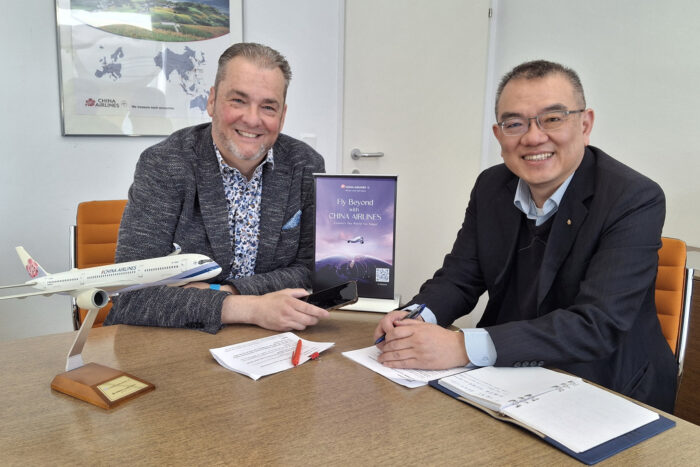
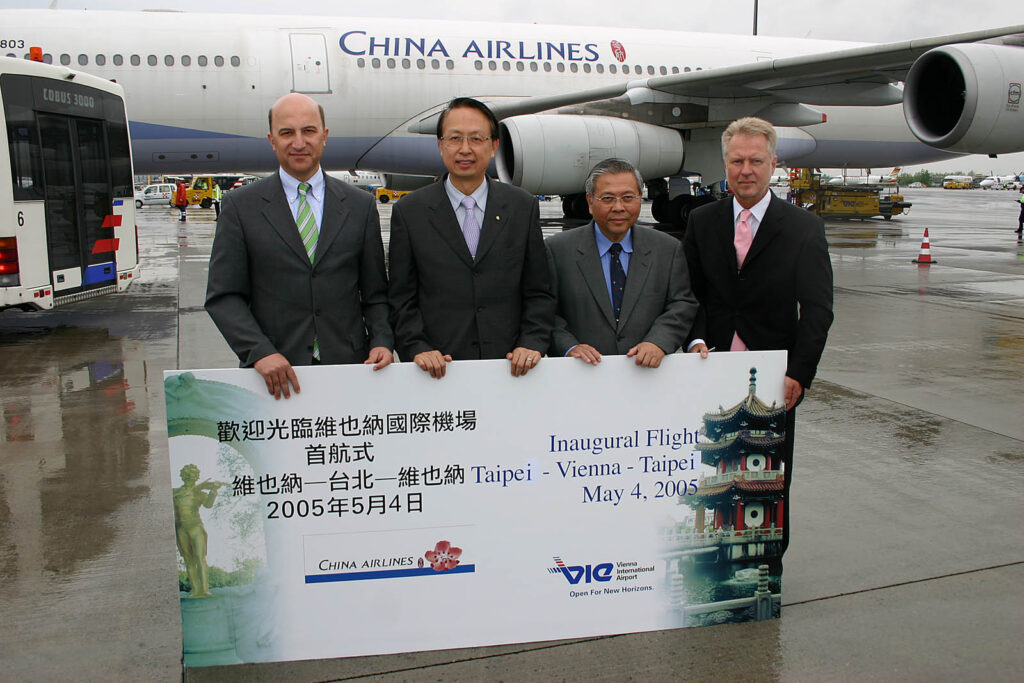
Last year, China Airlines not only celebrated its 20th anniversary in Vienna, but also welcomed Ray CHANG as its new Country Manager in Austria.
Myviennaairport.at spoke with the experienced aviation manager, who has been working for the Taiwanese airline for 30 years, not only about the current situation for China Airlines in Vienna, the possible expansion of its services, and the associated imminent acquisition of new aircraft, but also about China Airlines’ current situation during the Iran war and the associated consequences for the industry.
To start the conversation, may I ask you to tell us a little about yourself and your career at China Airlines?
Ray Chang:
I joined China Airlines in 1996 and am delighted to be celebrating my 30th anniversary with the company today. I originally started as an aeronautical engineer at China Airlines and then went to England to earn a bachelor’s degree in Air Transport Management. After completing my master’s degree, I returned to China Airlines and held various positions, including in fleet planning, until 2013. After that, my responsibilities within the company changed; I spent three years in Amsterdam as a marketing manager, then moved to Brisbane as general manager, returned to Taipei to oversee the project for the new Boeing 777-9 and Airbus A350-1000 orders, before coming to Austria as the new general manager in June 2025.
How well have you settled in, and what do you like about your new job location?
Vienna is a wonderful place! I used to live in England, and my job took me all over Europe, so I was already familiar with many places on the continent. But Austria and Vienna are a special place for me — I spent my honeymoon here in 2009, so naturally I have a special connection to it.
How challenging is the Austrian market for China Airlines?
Austria is indeed a challenge for China Airlines, as it is a market that is very much focused on leisure travel rather than business travel. However, Vienna is a very good hub for Central and Eastern Europe. We have changed our local strategy; we are entering the markets — especially the neighbouring Eastern European markets — directly operated by our own sales staff, instead of the contracted local GSAs (General Sales Agents).
How important these markets on the success of flights departing from Vienna?
Still limited at present, but we have noticed that they hold a great deal of potential, as more Taiwanese companies are becoming active in these markets.
How many passengers use the service from Vienna each year?
Around 55,000 passengers a year take advantage of China Airlines’ service from Vienna. However, it is still the case that only about 25–27 percent of passengers departing from Vienna are outbound, while the proportion of inbound flights from Taiwan and Asia is correspondingly high. This means there is still great potential for us: Currently, around 40 percent of passengers fly to Taipei, and the rest continue to destinations in Asia and beyond via our route network. Did you know, for example, that China Airlines is the largest foreign airline in Japan, serving as many as 12 destinations there via our hub in Taipei!
China Airlines operates flights from Taipei to Europe’s major cities — what role does Vienna play in this?
Amsterdam is, of course, significant due to the SkyTeam partnership with KLM, just as London and Frankfurt, with their more capacity (or flights) per week than Vienna, are naturally much larger markets than Vienna. The Austrian capital has been designated the “Gateway to the East,” but, like the new destination in Prague, it is more of a niche market.
How satisfied are you with the overall load factor on Vienna flights, and how are Business and Premium Economy Class on this route performing?
We are quite satisfied, as the overall load factor for our flights is over 80 percent and nearly 90 percent during the peak season in 2025. In the first four months of this year, our Business Class had a load factor of over 80 percent, and since we stepped up our promotion of our Premium Economy product last year, the load factor has risen to levels far exceeding our expectations.
How is the war in Iran currently affecting China Airlines’ business?
Very positively for more network passenger catchment, because all the Arab airlines have severely restricted their flight operations or suspended them entirely since the war began. Passengers are therefore unsettled and have been looking for airlines that fly directly to Asia. When the war began in late February, the volume of last-minute bookings increased massively through April. We can’t say how long this will last, but right now, as an Asian airline offering nonstop flights, we are benefiting from the situation. However, it’s inevitable to encounter the fuel cost rising at the same time.
Aren’t you concerned that the crisis might also weaken demand for travel to Asia?
Yes, that could very well happen; it is a reality for the industry, because travellers are worried and are already cancelling flights. The higher cost of living caused by the oil crisis could lead to smaller travel budgets for vacationers. Rising fuel prices naturally affect us as well, but those of us who work in the aviation industry have learned to deal with crises. As an airline, it is therefore important to constantly improve and remain competitive.
On your flights to Prague, the airline is using a former SAS A350 with more premium seats but fewer economy seats. Is this a type of aircraft you would also like to see in Vienna?
Like many airlines worldwide, we are facing a situation where there is not enough aircraft capacity due to delivery delays from aircraft manufacturers, which is why we have added the only former SAS A350 to our fleet. However, for operational reasons, this aircraft is only being used on the three weekly flights to Prague. But starting from next year, however, China Airlines will begin refurbishing the cabins of our A350-900 XWBs and configuring them with new-generation seatson board.
China Airlines has ordered the Airbus A350-1000XWB and the and 777-9 — will these aircraft also be seen in Europe?
Both aircraft types are initially intended to replace the existing fleet of Boeing 777-300ERs on the longest and busiest routes. Therefore, Boeing 777-9 is to be deployed mainly on routes to the trunk routs of United States, and the A350-1000 mainly on ultra-long routes suchas east cost of Unites States and among other destinations. However, the company is still considering where the aircraft will be deployed. The biggest advantage of the A350-1000 XWB is its range, so flights to London Heathrow are certainly a realistic possibility, especially during the winter times.
In this context, how do you see the chances of there being more flights to Vienna in the future?
Once the issue of the shortage of available aircraft is resolved, we would like to resume our six weekly flights to Taipei as soon as possible, just as we did before the outbreak of the COVID-19 pandemic. With the addition of flights to Prague, we have had to split our capacity. Whenever I speak with my colleagues in Taipei, I ask for more capacity on the Vienna route. But I’m not the only one asking for this—there are many requests of this kind, which is why we need more aircraft.
By when do you think these issues will be resolved?
The first new Boeing 787s are scheduled to be delivered from the second quarterof 2026, so we hope that the takeover will already provide some initial relief. Starting next year, around 10 to 12 additional aircraftare scheduled to be delivered to China Airlines. If I could have my way, five weekly Vienna-Taipei flights starting with the 2026/27 winter schedule — and perhaps a sixth starting with the 2027 summer schedule — would be ideal. Before I leave Vienna in three years, however, I still have one major mission: I want to launch a daily flight to Taipei. To do that, we would of course first need the necessary traffic rights; we are looking forward to the authorities’ support once application submitted.
Martin Dichler