
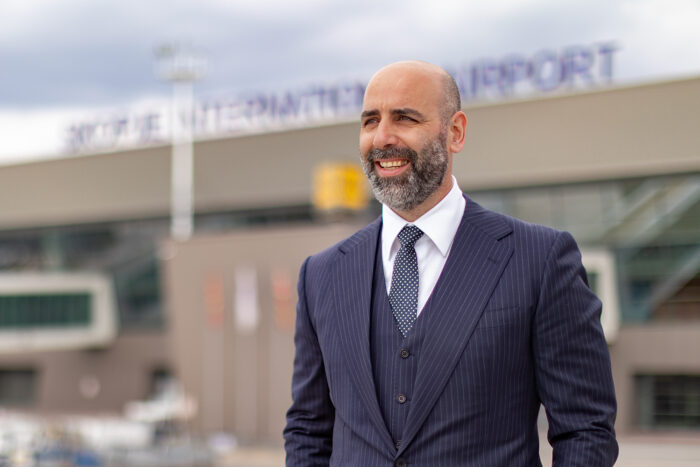
“We are transforming airports with cumbersome management systems from a state-owned to a privately managed model.”
For 15 years, TAV Macedonia, a subsidiary of Turkey’s TAV Airports Holding, has been operating the North Macedonian airports in Skopje and Ohrid. The results of this metamorphosis from a formerly state-owned to a privately run company are impressive.
Since 2010, the number of passengers handled has increased fivefold and new airlines have been recruited. In my interview TAV Macedonia CEO Nejat KURT talks about why Ryanair does not yet fly to North Macedonia but Wizz Air holds over 51 percent of the market share, the importance of the D-A-CH market, and why a master plan for beyond the end of the concession in 2032 is already in the works.
Martin Dichler:
Your company celebrated its 15th anniversary in North Macedonia this year. In a few words, what has happened at the capital’s airport since the takeover by TAV?
Nejat Kurt:
I would like to be able to describe our 15 years of operation in a few words, but I will try to be short and concise.
In March this year, TAV Macedonia celebrated its 15th anniversary in the Republic of North Macedonia. We celebrated it with a gala event in May, with all the important people for us who were part of our journey so far.
As a subsidiary of TAV Airports, TAV Macedonia began operations on March 1, 2010, taking over the management of the two Macedonian airports – Skopje International Airport and Ohrid St. Paul the Apostle Airport, from the Government, through a concession agreement.
Therefore, I would like to share with you that we have allocated over 300 million euros for capital projects that have enabled the country to gain two modern and high-quality airports, and thus become recognizable on the world map. We have invested in infrastructure, including the new terminal at Skopje Airport, the VIP terminal in Ohrid, the rehabilitation of the Skopje runway, we have installed advanced baggage screening systems, various IT and technical systems without which airport operations could not function. These investments have improved capacity, efficiency and quality of services. We have improved operational efficiency, which is a key characteristic for us, wherever we operate, because we, as TAV Airports, are transforming airports, which are cumbersome management systems, from a state-owned to a private management model.
Besides this, TAV Macedonia has achieved a significant economic impact – contributing over 160 million euros, by 2025, through concession fees, taxes, airline incentives and salaries. At both Macedonian airports, TAV Macedonia, together with its sister companies employs over 1000 people, most of whom are local employees. Between 2010 and 2025, we increased passenger traffic at Skopje and Ohrid airports fivefold, from 640,000 in 2009 to 3.2 million in 2024. This growth is the result of our successful efforts to attract key airlines and introduce over 40 new destinations, significantly improving international connectivity for business, tourism and leisure travel.
Has the airport in Skopje and Ohrid developed as TAV had hoped when it took over?
Yes, I can definitely answer with pleasure that our efforts to build and to maintain two Macedonian airports that will be recognizable and competitive in the world have been fulfilled. I am grateful and happy that dedicated, hard-working, professional people work at Skopje International Airport and Ohrid St. Paul the Apostle Airport, with whom, together, we have reached to a point where we are now.
I would like to point out that in addition to capital investments, TAV Airports, through TAV Macedonia, has focused largely on developing the expertise of local airport staff at Skopje and Ohrid airports through international training on ICAO, IATA and EU standards and practical experience with modern systems. With this, we have built cross-functional skills and aligned operations with global aviation trends. For us, the support we receive from the Government, especially from the Ministry of Transport, is also of great importance. In this regard, I would like to mention that we, as TAV Macedonia, have a program to stimulate new airlines and new airlines, something that allows us to be more competitive in the region, and thus to meet the company’s revenue goals. With this, the company will have a basis for new investments and implementation of new projects in 2026, of course keeping employees satisfied and motivated.
And what is the current trend in passenger numbers?
I am very pleased that the statistics of TAV Macedonia, especially for the last 9 months, record a positive trend of growth in the numbers of both Macedonian airports, both in terms of the number of passengers and the number of flights, results that once again confirm the success of our long-term strategy.
These results are not accidental; they are the result of careful planning and continuous dedication to grow air traffic and improve the services of both Macedonian airports. Expressed in numbers, from January to September, Skopje International Airport and Ohrid St. Paul the Apostle Airport served 2.6 million passengers and 20,141 flights.
The two Macedonian airports, Skopje International Airport and Ohrid St. Paul the Apostle Airport, served a total of 2,585,096 passengers in the first nine months, which is an increase of 6% compared to the same period last year. The number of flights, however, at the same time increased by 3%, i.e. both airports served 20,141 flights from the beginning of the year to September.
Only in September, the two Macedonian airports served 329,523 passengers, which is 8% more compared to the same period last year, and 2,422 flights were realized, which is 1% more than last year.
Separate analyses for the two airports for the period from January to September show that 2,375,264 were transported through Skopje International Airport, which is 5.4% more than last year, while Ohrid St. Paul the Apostle Airport recorded a double-digit increase of a high 16.2% with 209,832 transported.
North Macedonia now has 13 percent more passengers than before the pandemic. How do you see things developing in the future?
The Covid pandemic was a big challenge for the whole world, in every way. It was a period when literally everything stagnated. We have learned big lessons since then, but I am still happy that that period is already behind us and that things are functioning normally again.
In that direction, I would like to point out that for us, as the operator of the two Macedonian airports, that period was also difficult, but with constant effort we successfully overcame all crises. As I pointed out earlier when we talked about statistics, the increase in the number of passengers and flights actually shows that we are on the right track, and the successful cooperation with airlines and the Government has been fruitful. My expectations for the future are for the positive trend of growth in the numbers at the two Macedonian airports to continue, and yet to be based on long-term growth models.
Your concession agreement expires in seven years. What are your plans until then, and will TAV apply for an extension?
Yes, our concession expires in in 7 years. Given that we are very serious about continuing our work here as a foreign investor, I would like to mention that we have placed our ambitious intentions into a comprehensive master plan that we presented to the Government and the Ministry of Transport. What gives me great motivation for the future is the fact that I always share with pleasure that we have fulfilled all the obligations that we had under the concession agreement, although they were in large numbers.
We will continue to work with the same pace until the expiration of the concession agreement.
I would like to emphasize that I am very happy that we have similar perspectives with the current Government, because the development of airports in the capital cities and the surrounding areas contributes to the economic growth of the country.
We believe that we contribute a lot to the economy of the country.
The Master Plan is a comprehensive document, prepared with the support of TAV Airports’ majority owner, the French group ADP, which includes long-term development goals for the two Macedonian airports. The aim is to further develop the aviation industry in Macedonia and for both airports to become regional aviation hubs, competitive in the wider region.
Here I would like to make a paralel wih the airports in the region. Namely, Macedonias Airports concession period is finishing by 2032 while other airports consessions in this region will end in 2040 and even 2050, meaning that substantial investments can be made there having in mind that the time period for the Return of Investment (ROI) is bigger. We are always looking forward to commit for development and investment when the period allows us to return all that investment. Certainly, Macedonia should not stay behind the other regional airports’ development. I am confident that with the same focus and target for growth we are heading in the right direction. With the coordination and support of the Government, we are ready.
The terminal you built in Skopje is designed for a capacity of around 4 million passengers. Does a future airport operator need to consider possible expansion?
As I have indicated before, our master plan includes goals for the development of both Macedonian airports in the long term, a plan that also includes this segment and of course we follow the dynamics of Macedonian airports and aim for their maximum development.
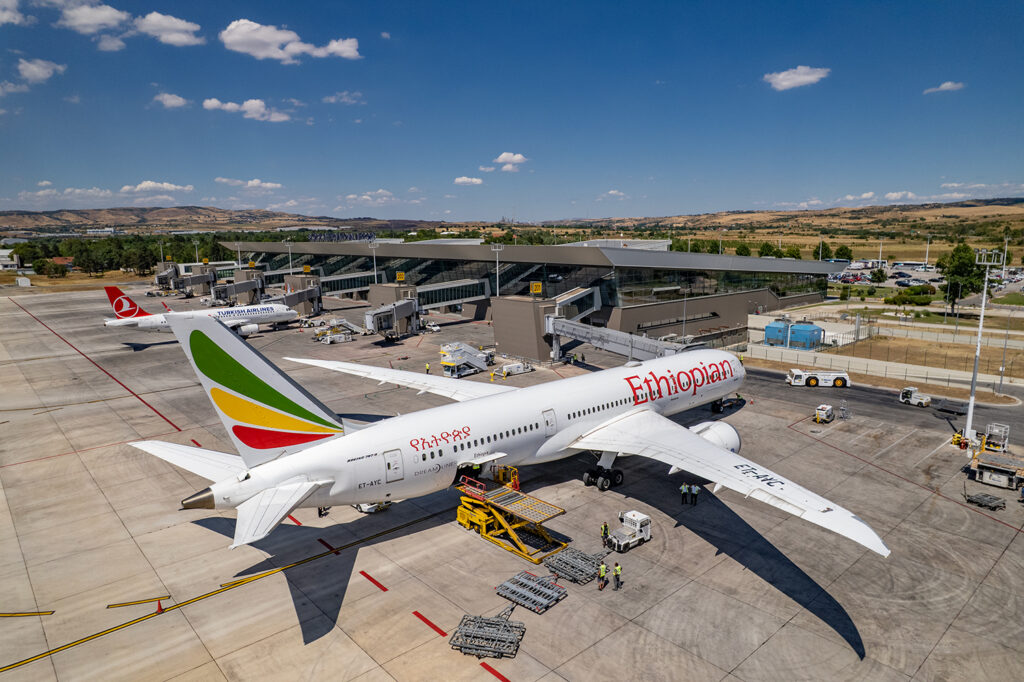
Skopje Airport recently welcomed a Turkish A350 and an Ethiopian B787 Dreamliner. Would the airport have the necessary infrastructure for long-haul flights, or would investment be required?
The runway of Skopje International Airport is technically prepared to accept certain types of wide-body aircrafts, in accordance with the defined operational and safety parameters.
This was confirmed by the welcome of the A350 (Airbus A350) and B787 (Boeing B787 Dreamliner) aircraft, which have already landed twice at Skopje Airport and transported groups of young athletes, arriving and departing, who participated in the European Youth Olympic Festival Skopje 2025, which took place from 20 to 26 July. For TAV Macedonia, as well as for the entire team at Skopje International Airport, servicing aircraft of this type is a great success and proof that Macedonian airports are successfully developing. This is also a reflection of how prepared TAV Macedonia, as an airport operator, is for the future of airports and aviation in general.
Numerous low-cost airlines fly to Skopje, why is Ryanair still not here?
As an airport operator we are ready to serve any airline that would like to start flying from both Skopje and Ohrid airports. Unlike other airport operators on other markets, as TAV Airports, and through our sister companies, we are offering all services that airlines need at any airport, starting from the complete ground handling services, terminal operations, commercial services, IT services, food and beverages, duty free shops.
Ryanair negotiated with the Government over the government subsidies for low cost airlines and as it was announced in the public both sides didn’t reach an agreement.
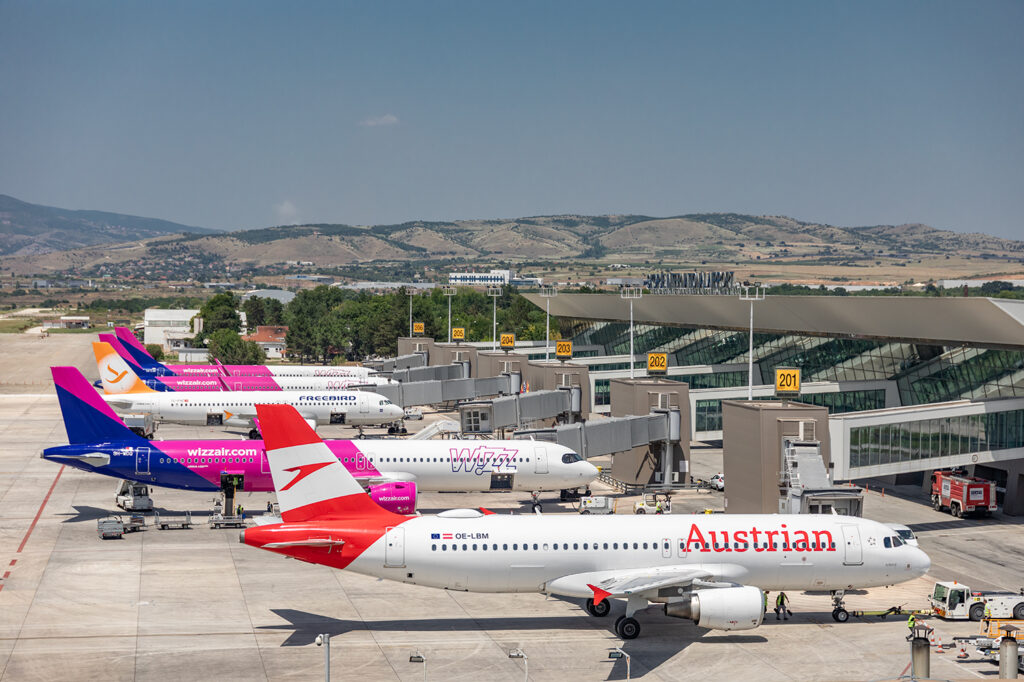
Wizz Air has more then 50% market share in Skopje. Doesn’t such a strong presence of a single airline pose a major risk?
Yes, it is true that Wizz Air has the largest share of traffic at Skopje International Airport, with 51.7%. This is the result of many years of successful cooperation and development of the low-cost model, which has largely opened our market. But that does not mean that there is a risk. Several other low-cost airlines currently operate at the airport, and we are constantly working to make the network as diverse as possible.
Our strategy is aimed at attracting new carriers and opening new destinations. So, although one low-cost airline has a significant presence, the market is stable, competitive and with constant growth in passenger traffic. In this regard we also need to take into consideration that Macedonia does not have a national airline nor a flag carrier, and this situation is successfully covered with the strong presence of Wizz Air, but also with traditional air carriers such as Turkish Airlines, Austrian Airlines, Lufthansa, LOT, which connect our citizens with the world through their hubs in Europe.
In which markets do you currently see potential for new connections?
Our negotiation team has focused this period on establishing direct connections to Denmark, specifically Copenhagen, Finland – Helsinki and the Middle East. From the existing markets, in the coming period we will focus on greater connectivity with Spain and the United Kingdom.
Direct flights to Doha and Dubai, as before the pandemic, are still a long way off. How difficult is it for Skopje to attract new airlines?
TAV Macedonia is in constant negotiations with Qatar Airways, Flydubai and Air Arabia to restore direct flights. From what we were told by the airlines, some of them are in the process of purchasing new aircraft and for this reason, for some time now, there has been a status quo in connecting this region with new markets and that in the meantime they are focused on existing markets. We are making every effort to restore these lines, which will be of great importance to us and to passengers, and I sincerely hope that every investment we make in expanding our network will soon see it as a realized project.
The Lufthansa Group has a strong presence in Skopje with flights operated by Austrian, Lufthansa, and Swiss. How important are connections to the D-A-CH region in general?
Connections with Germany, Austria and Switzerland are among the most important European connections for the country, both from an economic and social point of view. Lufthansa Group provides stability, frequency and global connectivity, something that low-cost airlines that fly only point to point cannot fully replace.
Ohrid Airport now has around a third less passengers than in 2019. What are the reasons for this?
The total number of flights at Ohrid Airport in 2019 was2.624, while the total number od passengers 317.218. This year, from January until September, or in the first nine months, the total number of flights at Ohrid Airport is 1626 and the total number of passengers 209.832
Ohrid Airport, due to the fact that it is located in the touristic center of the country, it is highly dependent from the seasonal and the chartered flights, and the overall success of tourism season on Ohrid Lake region. Ohrid Airport air traffic it actually producing the incoming tourism in Ohrid Lake region. Back in 2019, we had seasonal flights from many European destinations including flights from Tel Aviv, from April until October. Israeli tourists loved Ohrid and its historical and curtural heritage. As you may know, Ohrid is also known as the Jerusalem on the Balkans, because it has 365 churches, one for each day in the year.
However, covid crisis, and the global situations such as the war between Russia and Ukraine and the war Israel-Palestina, contributed to shifts in the global route network plans of airlines. Also, the changes in the offer of Ohrid Lake hoteliers contributed to reducing or stopping of some Easter European tour operators chartered flights, such as part of the flights from Poland to Ohrid.
We, as TAV Airports, are constantly marketing Ohrid Airport and Ohrid as a touristic destination that is worth to visit, on all aviation fairs we visit and in negotiations with airlines and tour operators, to attract them to start flying there. Therefore, I would like to stress that success in aviaton, especially for an airport with a seasonal character, lies in the cooperation and joint goal of all aviation and tourism stakeholders, and that is to bring, serve and accommodate more tourists with seasonal flights every year.
Years ago, there was talk of building a new terminal in Ohrid, but now it is being renovated. Why the change of the project now?
The project for the reconstruction and expansion of the St. Paul the Apostle Airport Ohrid is in the final administrative phase.
We are investing 2.7 million euros in this project, funds with which we will create a better space for both passengers who transit through this area and for airport employees who stay at their workplaces for hours. We are increasing the internal capacity, removing some offices from the interior to make it fully focused on passengers, and building an external facility where we will have enough space for offices, a kitchen and the entire space that will primarily be used by our employees as well as employees in the Police and Customs. The reconstruction process of the Ohrid airport will not interfere with the daily work and flow of passengers, we have taken into account all segments in detail so that the airport can function. The reconstruction will take place in several stages, and I expect it to be fully completed by March 2026.
Here, I must emphasize that the project for reconstruction of Ohrid Airport and the project for a new terminal building are two different projects. The second one is part of the master plan that I have explained earlier, which will follow the passenger traffic growth and the need for a bigger capacity.
Correct me if I’m wrong, but I get the impression that North Macedonia has not yet recognized the country’s full tourism potential. What role does TAV play here?
TAV Macedonia, as the concessionaire that manages the two Macedonian airports, has a significant role in the development of air transport and the accessibility of the country for tourists.
Its work is primarily focused on managing the infrastructure and providing efficient air services. On the other hand, the exploitation of the tourism potential depends on a broader strategy, state policies, promotion, local infrastructure and offer.
In other words, TAV is part of the system, but the key responsibility for tourism development remains with the institutions and tourism entities that need to create an integrated offer and a long-term vision.
We are happy that the Government understands what does aviation industry development mean for the whole national economy and on top of that what do airports mean as a critical infrastructure of the country together with highways. In this regard, we expect that finalizing the highway Skopje-Ohrid, will significantly improve Ohrid Airport future development prospects and contribute to incoming tourism growth and overall economy growth.
Looking across the border to Albania, air traffic there has undergone unprecedented growth within just a few years. In your opinion, could a similar development also be implemented in North Macedonia?
A development similar to that in Albania is absolutely possible in Macedonia, but several key prerequisites are needed. First, Albania has managed to increase air traffic by opening new airports, liberalizing the market and attracting low-cost airlines with favorable conditions and subsidies.
Macedonia already has positive experience with such models, especially through the airport in Skopje. In addition, long-term planning is needed, i.e. a joint strategy of the state and the private sector for connecting with European centers. And I believe that with good coordination, the country could achieve similar growth as Albania in a few years.
Martin Dichler